
Every moment in a vehicle’s lifecycle is really a question in disguise. Registration asks whether it exists and who’s responsible for it. Licence renewal asks whether that’s still true. Insurance asks whether it’s protected, and against what. The roadworthiness check asks whether it’s safe enough to be on the road. And if it ever crosses a border, the question becomes whether it’s allowed to leave, and allowed to come back. Same vehicle, same person behind it, one thread running through every question, yet for years, each one has been asked and answered in a different office, on a different form, in a different system, with no memory of what the others already know.
Transport is one of the parts of government that touches an ordinary life most often. Most people meet the state far more regularly through a licence renewal or a registration than through almost anything else. Which is why the way those moments are handled matters so much, and why the distance between them is felt so keenly.
When each chapter of a vehicle’s life sits in its own department, the ordinary things become heavy. A renewal that should take minutes turns into several offices and a morning away from work. Arrears build quietly in the space between systems. Compliance gaps widen where one office holds what another has yet to reach. And an officer at the roadside, checking a vehicle, sees only a sliver of a story that lives in full somewhere else.
ICE TIS brings that whole story into one place. It takes the full life of a vehicle- registration, licensing, roadworthiness, insurance, operator management, and enforcement- and holds it as one living record that every authorised agency works from in real time. The chapters stop being scattered. They become one account of the same vehicle and driver, current and shared.
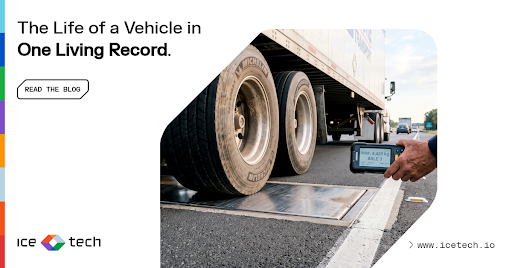
You can feel the difference from wherever you stand in the system. A citizen renews a licence, books an inspection or settles a fee from a phone or a browser, on their own time. A field officer, with ANPR and a handheld device, pulls up a vehicle’s particulars, its infringement history, and the validity of its licence in the moment, at the roadside, from the same record. Arrears and penalties accrue automatically against that record, so compliance keeps pace with reality rather than catching up to it later. And when a vehicle reaches a border, the compliance story travels with it.
For a government, this is a clearer view of something it has always needed to see. A complete, current picture of every registered vehicle and licensed driver in the country. Revenue that reflects what is actually on the road, because the system accrues what is owed as it happens. Enforcement that rests on live information rather than yesterday’s copy. The transport department stops managing scattered records and starts managing one connected environment.
For the citizen, it is simpler and kinder. The errand that once meant a queue and a day away becomes an online process, from a desktop or a phone. The vehicle that has served a family for years is recognised as one vehicle, with one history, by a government that already holds its story.
ICE TIS is built on the same ICE Engine foundation that connects the wider work of government, applied here to the world of transport and mobility. Across Africa, transport systems are being modernised with real ambition, and a single, living record of every vehicle and driver is part of how that ambition becomes everyday reality.
Because in the end, every vehicle has a story, from its first plate to its last journey. ICE TIS keeps that story whole.
One vehicle. One record. One connected transport system.


