
There is a small, familiar moment that most people have lived through. You need a government service: a driver’s licence, a vehicle licence, a new vehicle registered. You take a morning off work and stand in a long line. When you finally reach the front, you are turned away because you don’t have a certified copy of your identity document, or your proof of address is too old. Tomorrow, you start again.
It is easy to blame the official at the counter. The real cause usually sits further back. Government systems tend to grow one need at a time. A system to register a vehicle. A system to issue an identity document. A system to take a payment. Each is built with care, each solves its own problem well, and each keeps its own copy of you. Years later, a single person’s information is spread across dozens of these systems, with very little joining one to the next. So every service asks you to prove yourself again, on paper and in person.
ICE Engine starts from that picture, and changes where the story begins.
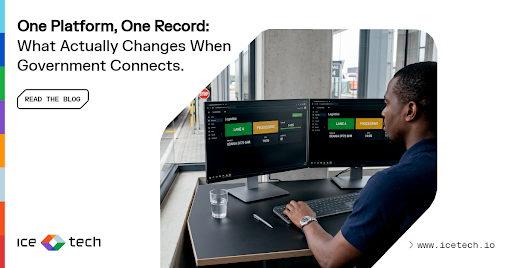
Rather than adding one more system to the pile, ICE Engine is the foundation that connects them all. At its heart sits a process orchestration engine and a built-in, low-code application builder, which is a technical way of saying two things. Identity, licensing, payments and compliance work from one shared foundation instead of many. And a government can shape a new service by configuring it on the platform, rather than building it from the ground up each time.
The effect is easiest to see when information is captured once and used many times. Vehicle registration, vehicle licensing and driver licensing are often handled by separate systems. Integrated through ICE Engine, they draw on the same data, which becomes the primary source for the whole transport system environment. Role-based access keeps every view secure, and every interaction stays traceable, so trust and accountability travel with the information. The systems a government already relies on stay in place. ICE Engine connects them, so they finally speak with one voice. The same principle extends to tolling, enforcement and borders.
For the teams inside the government, that changes the day-to-day. Oversight begins to reflect what is actually happening across departments rather than one slice of it. Revenue becomes easier to follow and harder to lose in the spaces between systems. New services arrive with quicker turnaround times, shaped by the people who understand the environment, because ICE Engine is configured rather than re-coded from scratch.
For the citizen, the change is quieter and lands harder. The errand that once meant a day away from work can be done online, from a desktop or a phone. Instead of applying on different platforms for different services, there is one recognisable government platform, a single login and one list of services to choose from, with your identity document and proof of address uploaded from home.
There is a practical side to this that matters for governments who want to digitise the fastest. ICE Engine is light to deploy and light to maintain. It runs on cloud-native principles, on-premises or in a sovereign cloud, and reaches people through modest mobile devices as readily as full desktops. A government can begin without first building vast infrastructure. It can start where it is, and grow from there.
That, in the end, is what a foundation is for. It is less the thing you notice, and more the thing everything else stands on. Governments across Africa are building real services on the platform, and are continuing to build. A strong foundation is what lets the next idea arrive sooner than the last.
One platform. Integrated records. A government that works as one.


