Spend an hour at a busy land border and you notice the waiting before anything else. A driver sits in a cab that has been idling since before dawn, paperwork on the dashboard, watching the queue move the length of a truck every few minutes. Somewhere ahead, a customs officer is working through a stack of declarations. An immigration desk is checking documents one traveller at a time. An inspection team is verifying a load. Each of them is doing their job, and doing it well. The driver simply has to clear all of them, one after another, before the road opens up again.
A border crossing looks like a single line on a map. Up close, it is a sequence of decisions, each belonging to a different agency, each with its own process. The time a crossing takes rarely lives in any single step. It lives in the distance between the steps, while information catches up with the vehicle.
That distance matters because a border carries two responsibilities at once. It has to let legitimate trade and travel move. And it has to check what crosses, collect what is due and keep the country secure. When each agency holds its own part of the picture, those two responsibilities pull against each other, and thorough checking costs the one thing the queue has least of, which is time.
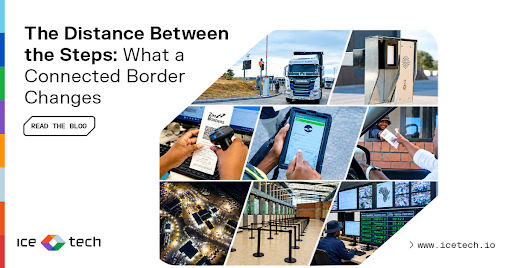
ICE Borders closes that distance by connecting the agencies at a crossing within one integrated system. At entry, each vehicle receives a QR-coded coupon linking its class, route, payment and compliance status, and that coupon is validated electronically at every checkpoint. Automatic number plate recognition cameras, smart booms and directional traffic control guide compliant vehicles forward and route others to inspection, while mobile inspection applications bring digital records to the point of checking. Commercial operators and travellers can pre-register, pre-pay and print their coupons before they arrive, so the crossing is already underway by the time they reach the gate.
Once the agencies share the same verified information, the two responsibilities begin to support each other. A vehicle whose status is confirmed moves forward with confidence. Attention shifts toward the movements that warrant a closer look, which now stand out clearly against the ordinary flow. Each agency keeps its own mandate and its own systems, and each acts on the same picture in real time.
For a government, this is where a connected border earns its place. Compliance decisions become faster and more consistent. System-driven rules authorise movement through the site, strengthening control. Payment is confirmed before a vehicle can leave, and every passing vehicle is reconciled against what was collected, protecting revenue at every crossing. A master control room gives border management a live view of performance, including where congestion is building, so operations can respond as the day unfolds.
For the driver in the cab, the change is felt in less time idling at the border, and more time on the road, reaching the destination with a quicker turnaround . Behind every truck in the queue is someone whose rest, income, and time at home depend on how well the border moves. When clearance becomes more predictable, drivers plan with more certainty, logistics companies commit to delivery times with greater confidence, and the traders and local businesses that depend on border activity share in a crossing that works with discipline and pace.
Across Africa, trade moves along these corridors load by load, and every load carries someone’s plan, someone’s livelihood, someone’s promise to be somewhere by a certain day. ICE Borders is built so that a border keeps its rigour and its security while giving back the time that everyone in the queue has always paid for.
Every agency. One shared picture. A crossing that moves together.