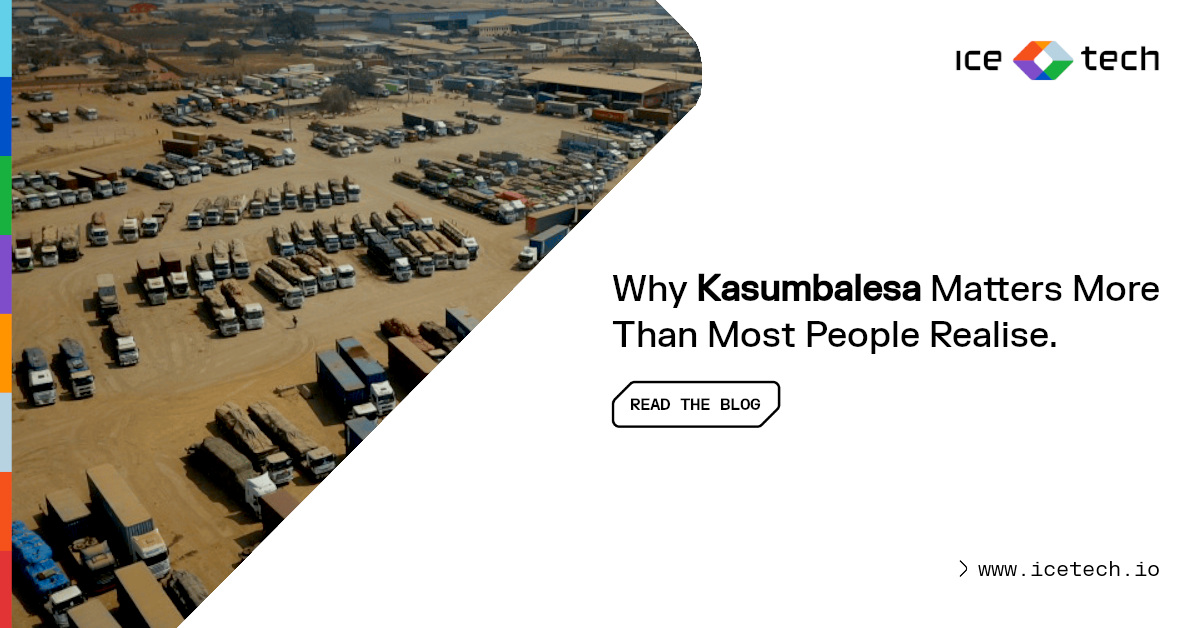
Kasumbalesa rarely appears in conversations about African economic opportunity. It sits at the border between Zambia and the Democratic Republic of Congo, a few kilometres from Chililabombwe, and most people encountering it for the first time are struck less by its strategic importance than by the sheer density of life that seems to have found its way here. Rows of trucks stretching 25 kilometres back from the crossing. Traders carrying goods on foot alongside heavy freight vehicles. Warehouses that appear to have grown almost overnight to meet a demand that arrived faster than the infrastructure around them.
That concentration of activity is itself worth pausing on. It tells you something is drawing people and cargo here, again and again, across distances that make the journey far from straightforward.
The Gateway to the Copperbelt
Before anything else, it helps to understand what sits on the other side of this crossing.
Zambia’s Copperbelt is one of the world’s largest copper and cobalt producing regions. These are minerals at the centre of the global energy transition, feeding battery supply chains and infrastructure projects that stretch across every continent. The volumes moving through Kasumbalesa are measured in billions of dollars annually. Every truck in that 25-kilometre queue is carrying something that matters to someone, somewhere, well beyond this border.
That economic weight is what makes the modernisation of this crossing so consequential. This is not a border management project. It is infrastructure for a critical corridor in the global economy.
The Crossroads of a Continent
Five of Africa’s most significant trade corridors converge at Kasumbalesa. The North-South Corridor links the crossing to Durban in the south. The Central Development Corridor reaches east toward Dar es Salaam. To the west, the Walvis Bay-Ndola-Lubumbashi Corridor opens onto the Atlantic. Beira and Lobito complete the picture. Add Mombasa through East Africa’s network, and what you are looking at is a single land crossing connected to virtually every major maritime gateway on the continent.
Ten SADC member states sit within the web of these corridors. For any business thinking seriously about reaching Central Africa, this crossing is often the most direct answer to the question of how to get there.
The Market Waiting on the Other Side
The DRC carries a weight of opportunity that the continent is still learning to fully act on. Its copper and cobalt reserves sit at the centre of the global energy transition. Its population of over 100 million people remains largely underserved by formal supply chains. Lubumbashi, the country’s second city, lies roughly two hours from the border. From there, goods move deeper through a network of traders who understand the terrain in ways that formal logistics models are still learning to account for.
That supply chain has been functioning for decades. Small-scale traders, transporters, intermediaries, all working within a system that carries goods from Zambia’s Copperbelt deep into the DRC’s interior. Walk through the market at Kasumbalesa and you see it clearly: mealie meal, hardware, textiles, agricultural produce, all flowing across a line that separates two economies with deeply complementary needs. Behind every transaction is a person who made a decision, weighed a margin, and trusted the corridor to deliver.
That trust accumulates into something real. It is why the trade here persists even when conditions are challenging.
Why the Pressure on This Border Is Growing
Kasumbalesa is the second busiest land border in the SADC region, after Beitbridge between South Africa and Zimbabwe. That position reflects decades of accumulated commercial gravity. It also reflects the reality that as African trade grows, and as AfCFTA ambitions translate into tangible volumes, a border this central to regional commerce comes under more pressure than infrastructure built for earlier conditions can comfortably absorb.
This is the context behind the sustained attention Kasumbalesa has received at the highest regional levels. SADC ministerial meetings, bilateral frameworks between Zambia and the DRC, technical working groups drawing in ten member states. The conversation is serious because the stakes are serious. What makes these discussions productive is when they move from recognition of the challenge toward implementation of systems designed for how the border actually operates, at scale, every day, rather than for the conditions that are easier to model on paper.
What ICE Tech Is Doing Here, and Why It Matters
ICE Tech has been building and operating government systems since 2011. Our core team carries an average of over twenty years of experience in government technology specifically, and we hold registered offices in Zambia. We understand this environment from the inside, and we have built a track record that reflects that understanding.
The clearest evidence of what this approach delivers is Beitbridge. Africa’s busiest land border, where our solution reduced freight waiting times from over 72 hours to an average of 3 hours. Compliance moved from under 30 percent to near 100 percent. Revenue collection strengthened significantly. The same solution is the foundation of what is live at Kasumbalesa today.
What we are doing at Kasumbalesa is worth describing precisely, because the nature of the work matters.
We are integrating the government systems that already exist at this crossing, connecting agencies that were operating in isolation and creating a shared operational picture. We are replacing paper-based processes with digital ones, so that a declaration has visibility, accountability, and a clear trail from submission to clearance. And we are automating traffic management, so that the movement of people and goods through this crossing happens with precision and purpose rather than manual coordination under pressure.
This is integration work, as much as it is technology work. We are building around how the border actually functions, connecting what is there and making it work as a coherent whole.
What This Means for the People at the Crossing
The numbers tell part of the story. But the more important question is what they mean for the people who move through this crossing every day.
For a truck driver who has spent three days parked on the approach road, watching their cargo sit in the sun and their delivery window close, a system that processes their declaration in hours rather than days is a material change in their livelihood. For a small-scale trader who has been carrying goods on foot and waiting in line since before dawn, a crossing that moves with clarity and accountability is a crossing they can plan around. For the businesses and intermediaries further along the supply chain, a border that performs consistently is one they can build commercial relationships on.
That is the version of modernisation that holds. When the people who rely on a system daily can feel the difference, the system has done its job.
What This Means for Businesses on the Corridor
If your business sits anywhere along these trade corridors, or if you are evaluating entry points into Central African markets, Kasumbalesa is a border worth understanding in real terms. The volume of activity here is a product of genuine demand. And genuine demand at this scale is a signal that the market is active and growing.
The investment in digital border management, real-time data exchange, and coordinated customs processing is already underway. Businesses that understand the corridor as it is evolving, and position themselves accordingly, are the ones with the clearest advantage as conditions continue to improve.
At ICE Tech, our presence at Kasumbalesa reflects what we have learned across years of working at African borders: the real opportunity lies in building systems that work with the complexity of a place like this, designed around how it actually functions, rather than how we wish it would. The corridor carries enormous potential. The work we are doing here is about helping that potential move.